msg_protocol
更新日期:2026/2/1
参与者:KkarinL15
源码地址:message-protocol
函数调用
在初始任务中
- 调用
message_register_send_uart(msg_id_t msg_id, UART_HandleTypeDef *huart,uint32_t buf_size)注册串口消息通讯句柄; - 调用
message_register_polling_uart(msg_id_t msg_id, UART_HandleTypeDef *huart,uint32_t buf_size, uint32_t fifo_size)注册数据接收串口句柄; - 调用
message_register_recv_callback(msg_id_t msg_id,msg_recv_callback_t msg_callback)注册接收回调函数指针; - 完成以上注册后创建
message_polling_task任务为后续轮询函数做准备。
调用message_send_data函数发送数据。
在message_polling_task任务中调用message_polling_data函数轮询消息队列读取数据。
数据结构体
msg_fifo_t
环形缓冲区
typedef struct {
    uint32_t size;          /*!< 缓冲区大小 */
    uint32_t mask;          /*!< 大小掩码 */
    uint8_t frame_len;      /*!< 帧长度 */
    bool new_frame;         /*!< 是否是新的一帧 (写长度用) */
    volatile uint32_t head; /*!< 头指针 */
    volatile uint32_t tail; /*!< 尾指针 */
    uint8_t buf[0];         /*!< 缓冲区 */
} msg_fifo_t;
msg_instance
消息队列管理结构
struct msg_instance {
    msg_recv_callback_t recv_callback; /*!< 接收回调函数 */
    UART_HandleTypeDef *send_uart;     /*!< 发送串口句柄 */
    UART_HandleTypeDef *recv_uart;     /*!< 接收串口句柄 */

    uint8_t *send_buf;     /*!< 发送缓冲区 */
    uint32_t send_buf_len; /*!< 发送缓冲区大小 */

#if MSG_ENABLE_RTOS
    SemaphoreHandle_t send_buf_semp; /*!< 发送缓冲区二值型号量 */
#endif                               /* MSG_ENABLE_RTOS */

    uint8_t *recv_buf;      /*!< 接收缓冲区 */
    uint32_t recv_buf_size; /*!< 接收缓冲区大小 */

#ifdef MSG_ESC
    bool escape; /*!< 是否要将下一个字符转义 */
#endif           /* MSG_ESC */

    msg_fifo_t *fifo;          /*!< 接收缓冲区 */
    uint32_t fifo_element_len; /*!< 当前队列元素个数 */

#if MSG_ENABLE_STATISTICS
    uint32_t send_count; /*!< 发送计数 */

    uint32_t recv_success; /*!< 接收成功计数 */
    uint32_t recv_error;   /*!< 接收错误计数 */
#if MSG_ENABLE_CRC8
    uint32_t crc_check_error; /*!< CRC 校验错误计数 */
#endif                        /* MSG_ENABLE_CRC8 */

    uint32_t max_fifo_element_len; /*!< 最大队列元素个数 */
    uint32_t fifo_overflow;        /*!< 队列溢出清空计数 */
#endif                             /* MSG_ENABLE_STATISTICS */
};
各项辅助功能
-
启用线程安全处理:
MSG_ENABLE_RTOS启用后会使用互斥信号量来保护发送缓冲区(仅支持
FreeRTOS)。
-
启用转义标识:
MSG_ESC为了做到透传(即原样、完整地将数据从发送端转发至接收端),消息会对内容转义。定义
MSG_ESC可以选择转义字符(建议选择出现频次低的字节)。
-
启用始能统计:
MSG_ENABLE_STATISTICS统计每种消息的接收情况(接收成功、错误计数,内存分配失败计数,队列长度与最大深度等)。
-
启用
CRC校验:MSG_ENABLE_CRC8检验传入数据和数据长度。(需接收方与发送方同时开启,否则数据解析时数据会被误判为脏数据)
CRC8和CRC16的区别在于校验长度有区别和返回的校验值位数不同;CRC8的校验码为1byte,CRC16的校验码为2byte。
辅助功能的启用
宏定义MSG_ENABLE_RTOS为1
-
在
message_register_send_uart中使用信号量保护发送缓存区
-
在
message_send_data中
宏定义MSG_ENABLE_CRC8为1
-
在
message_send_data中得到
CRC8校验值#if MSG_ENABLE_CRC8 /* CRC8 校验结果 */ uint8_t crc8_value = calc_crc8(data, data_len); #endif /* MSG_ENABLE_CRC8 */将
CRC8校验值拆分为两个字节存入数据帧
-
在
message_data_dequeue中定义
CRC8校验值变量#if MSG_ENABLE_CRC8 /* 接收到的 CRC8 校验值 */ uint8_t crc_recv; /* 计算得到的 CRC8 校验值 */ uint8_t crc_value; #endif /* MSG_ENABLE_CRC8 */检验数据包长度与实际接收长度是否一致
/* 验证数据包长度与实际接收长度是否一致, 数据包第二个字节是长度 */
#if MSG_ENABLE_CRC8
        /* 1 byte 标识, 1 byte 长度, 1 byte 结束符, 1 byte FIFO 元素大小
         * 2 byte CRC8 校验值
         * 总共 6 byte. */
        if ((frame_len - 6) != fifo->buf[(fifo->head + 2) & fifo->mask]) {
#else  /* MSG_ENABLE_CRC8 */
        /* 1 byte 标识, 1 byte 长度, 1 byte 结束符, 1 byte FIFO 元素大小
         * 总共 4 byte. */
        if ((frame_len - 4) != fifo->buf[(fifo->head + 2) & fifo->mask]) {
#endif /* MSG_ENABLE_CRC8 */
当数据被分成两段时如下处理(再进行校验)
#if MSG_ENABLE_CRC8
                call_len = frame_len - 6;
#else  /* MSG_ENABLE_CRC8 */
                call_len = frame_len - 4;
#endif /* MSG_ENABLE_CRC8 */
校验
CRC8#if MSG_ENABLE_CRC8 /* 校验 CRC8 */ crc_value = calc_crc8(call_data, call_len); /* 接收到的 CRC8 校验值 */ crc_recv = (call_data[frame_len - 5] & 0x0F) | (call_data[frame_len - 6] << 4); if (crc_value != crc_recv) { /* 校验结果不一致, 出队到下一个 */ fifo->head += frame_len; --msg->fifo_element_len; #if MSG_ENABLE_STATISTICS ++msg->crc_check_error; #endif /* MSG_ENABLE_STATISTICS */ continue; } #endif /* MSG_ENABLE_CRC8 */
数据发送
流程如下:
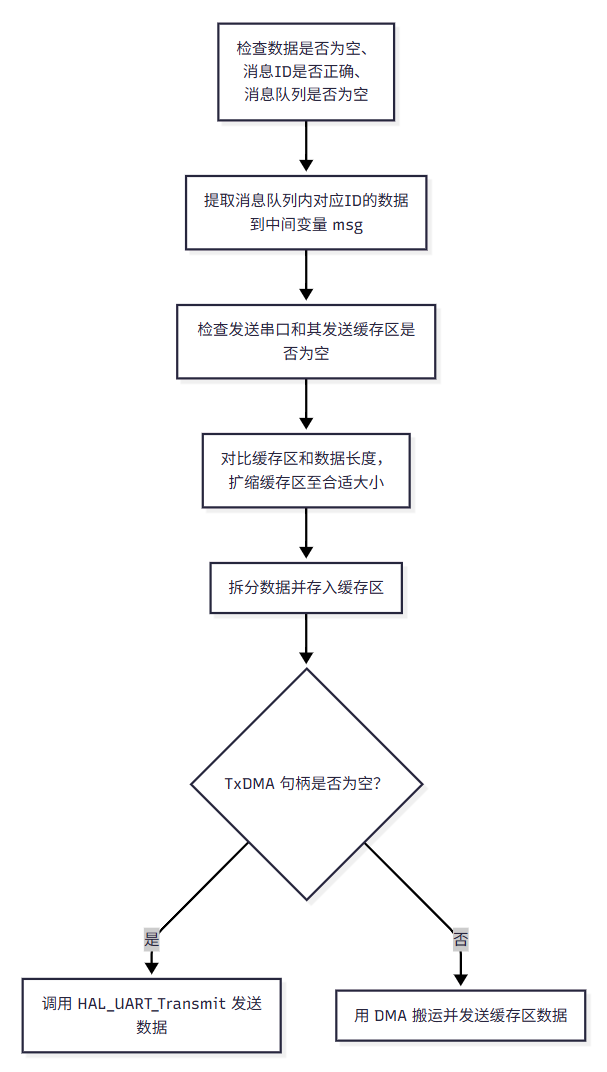
扩缩缓存区
if (msg->send_buf_len <= data_len + 5) {
        /* 不够 */
        uint8_t *new_buf = (uint8_t *)MSG_REALLOC(msg->send_buf, data_len * 2);
        if (new_buf == NULL) {
            return;
        }

        msg->send_buf = new_buf;
        msg->send_buf_len = data_len * 2;
    } else if ((data_len + 3) * 3 <= msg->send_buf_len) {
        /* 有余*/
        uint8_t *new_buf =
            (uint8_t *)MSG_REALLOC(msg->send_buf, msg->send_buf_len / 2);
        if (new_buf == NULL) {
            return;
        }

        msg->send_buf = new_buf;
        msg->send_buf_len = msg->send_buf_len / 2;
    }
- 不够(缓存区长度 <= 数据长度+5):将缓存区的长度扩为当前数据的两倍。
- 有余((数据长度+3)*3 <= 缓存区长度):将缓存区的长度缩到原来的1/2。
数据拆分
缓存区数组(uint8_t类型)第一字节高四位标记数据ID,低四位标记数据类型;第二字节标记数据长度;第三字节开始将数据复制到字节流;最后一个字节用帧结束标志MSG_EOF结尾。
轮询接收的数据
流程如下:
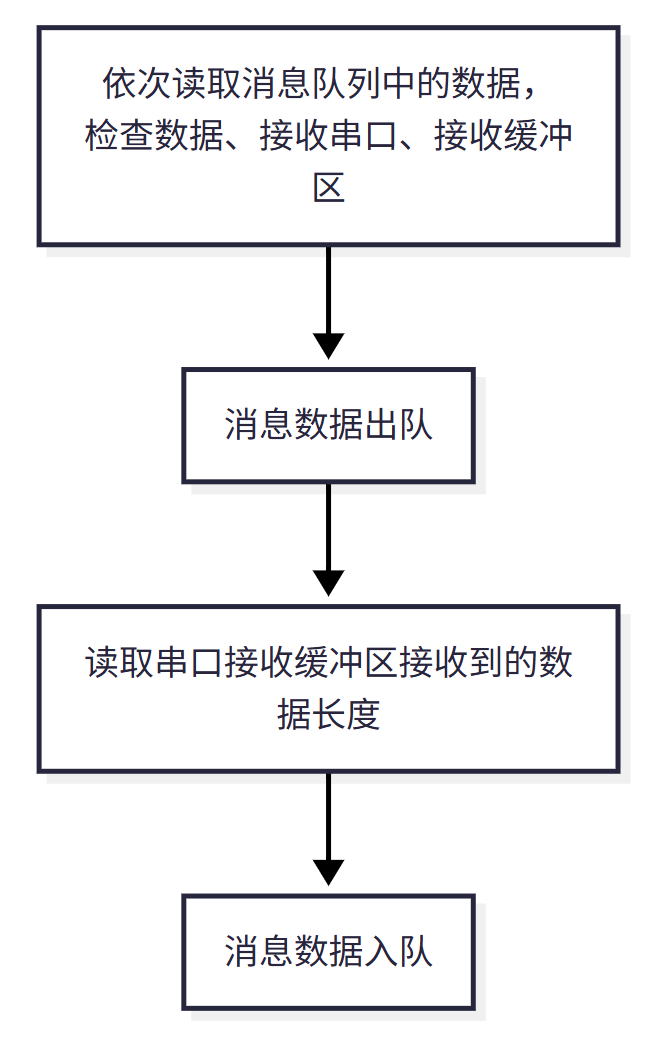
消息数据入队
把从串口读到的字节写入环形 FIFO,遇到 MSG_EOF 完成一帧并在帧前预留的位置写入该帧在 FIFO 中的总长度。
if (fifo->new_frame) {
            /* 空一个字节写长度, 长度写 0 */
            fifo->buf[fifo->tail & fifo->mask] = 0;
            ++fifo->tail;
            fifo->new_frame = false;
        }

        /* 将数据写入队列 */
        fifo->buf[fifo->tail & fifo->mask] = msg->recv_buf[i];
        ++fifo->tail;
        ++fifo->frame_len;

        if (fifo->size == (fifo->tail - fifo->head)) {
            /* FIFO 已满, 先覆盖旧数据, 有新的帧直接清空 FIFO, 从头开始存 */
            fifo->head = 0;
            fifo->tail = 0;
            msg->fifo_element_len = 0;
            fifo->frame_len = 0;
环形缓冲区,注册数据接口时传入的队列大小参数必须为2的幂次方。代码里用位掩码替代取模来做索引环绕:msg_fifo_init 把 mask = fifo_size - 1,然后在读写时用 index & mask 访问缓冲区(例如 fifo->buf[fifo->tail & fifo->mask])。只有当 fifo_size 是 2 的幂时,fifo_size-1 的二进制是低位全 1,index & mask 等价于 index % fifo_size,才能正确、快速地做环绕索引。若不是 2 的幂,& mask 不再等同于取模,会导致索引错误和数据混乱。
回调函数
回调函数参数形式必须是void func(uint32_t, uint8_t, uint8_t*)第一个参数是消息长度, 第二个参数是消息标识 (高四位是 ID, 低四位是数据类型),第三个参数是数据区内容, 无返回值。
消息数据出队
从 FIFO按帧读取数据,校验帧长度(和 CRC8 可选),把完整帧拷贝到 recv_buf(处理跨界情形),并在校验通过时调用注册的回调 msg->recv_callback对消息ID调用相应回调函数。